What is fluoride?
According to the World Health Organization, access to fluoride is an inalienable right for the protection of oral health, and it is considered one of the most important discoveries in public health (FDI, IADR, WHO 2006: Global Consultation on Oral Health Through Fluoride). Fluoride is an element found freely in nature, in water, in foods and elsewhere. In European countries and in America, fluoride has been added to drinking water, and a reduction in tooth decay of up to 50% has been observed.
Is fluoride useful?
Fluoride is the most effective tool dentistry has today for preventing tooth decay and making teeth more resistant.
With fluoride, tooth enamel becomes more resistant to the acids produced by bacteria in the mouth. Enamel has a crystalline structure, and fluoride enters these crystals, making them extremely resistant to the acids that cause tooth decay. Fluoride also combines with the calcium in the teeth to form calcium fluoride compounds, which greatly help repair the enamel every time decay-causing acids damage it, especially after meals. Its action on the enamel is therefore mainly topical, making it harder and more resistant to the decay-causing acids produced by bacteria in the mouth. At the same time, it has a mild antibacterial effect, as it can neutralize some of the bacteria in dental plaque.
What is fluoride treatment?
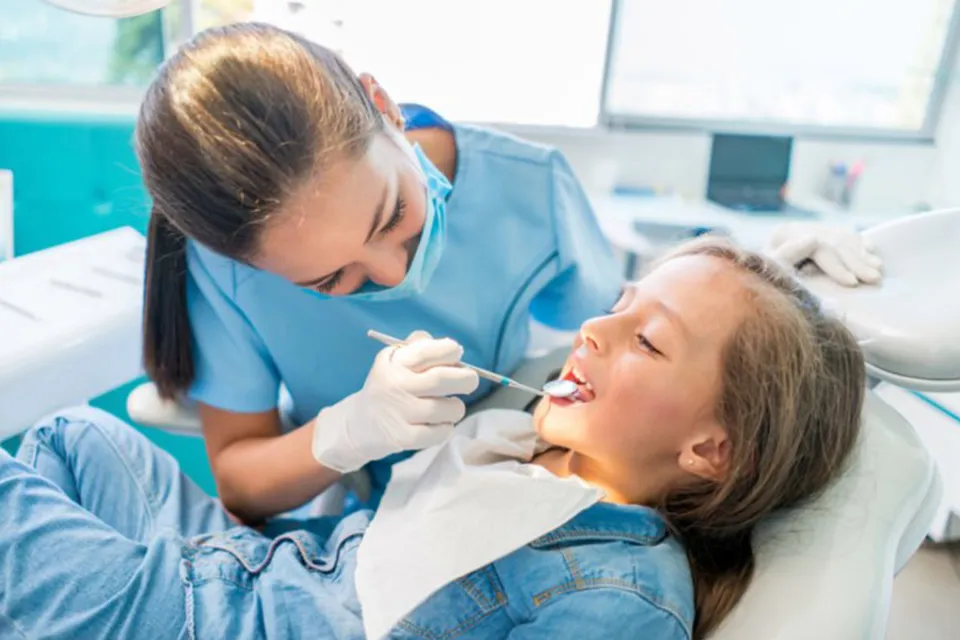
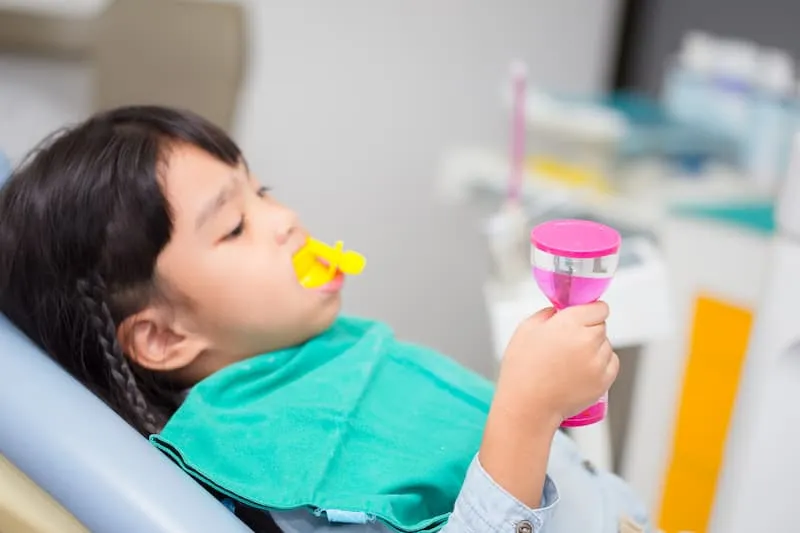
Fluoride treatment is a procedure in which the dentist applies fluoride gel directly to the surface of the teeth using special plastic trays. In some cases, fluoride varnish may be used instead. The application is done only at the dental office, and always with a saliva ejector to remove the fluoride from the mouth and keep the child from swallowing it. This fluoride is highly concentrated and is not recommended for use at home by parents and children. For children, fluoride treatment is recommended after a professional dental cleaning. The procedure takes no more than 2 minutes, and parents should know that after the treatment, the child should not eat or drink anything (not even water) for 30 minutes, so that we get the maximum benefit.
What is the purpose of fluoride treatment?
The purpose of fluoride treatment is to strengthen the teeth and protect them from tooth decay. Fluoride treatment can be used:
- preventively, in children who have not had any tooth decay
- therapeutically, in children whose teeth have early-stage or extensive tooth decay. In this case, fluoride is used to halt the action of decay-causing bacteria.
When do children need fluoride treatment?
Fluoride treatment is recommended starting at the age of 3–4, once all the baby teeth have come in. Depending on the child’s risk of tooth decay (that is, how many decayed teeth, cavities or holes they have), the dentist decides at what age fluoride treatment should begin and how often it should be repeated. Specifically, topical fluoride application is usually recommended once, twice or more times a year, depending on the child’s needs, and together with regular check-ups of the teeth and mouth it contributes greatly to reducing tooth decay. In children at higher risk of tooth decay, it should be done 3–4 times a year.
In what other ways can a child get fluoride?
Fluoride is present in small concentrations in foods we eat every day, such as tea and fish, but this is not enough to protect the teeth. Studies have shown that adding fluoride to drinking water at a certain concentration (one part per million, or 1 ppm) can prevent up to 60% of tooth decay. At this concentration, fluoride is completely harmless to the body.
In Greece, both the central water supply and most local water networks contain negligible amounts of fluoride.
For this reason, alongside fluoride treatment at the dental office, fluoride should also be obtained in other forms to help prevent tooth decay.
Should I use fluoride toothpaste for my children?
Fluoride toothpaste is considered the most important means of preventing tooth decay today, and its widespread use after 1980 is considered the main reason for the decline in tooth decay in the Western world. Studies have shown that regular use of fluoride toothpaste can reduce tooth decay by 20–40% or more, thanks to the topical action of fluoride.
Children up to the age of 2 should use toothpaste with a reduced amount of fluoride (250–500 ppm F); children aged 2 to 6 can use toothpaste with at least 1000 ppm F; and from the age of 7, children can use regular toothpaste, which usually contains up to 1450–1500 ppm. Teeth should be brushed twice a day, and one of those times should always be at night.
Fluoride mouth rinses are given after the age of 6–7, when the child is able to avoid swallowing the rinse. Products with different fluoride concentrations are available, and they are given to the child on the dentist’s recommendation, according to the child’s needs.
Quick answers
Is fluoride safe for my child?
At the concentration used in fluoridated drinking water (1 ppm), fluoride is completely harmless to the body. The highly concentrated fluoride used in fluoride treatment is applied only at the dental office, with a saliva ejector so the child does not swallow it, and is not recommended for home use.
At what age should my child start fluoride treatments?
Fluoride treatment is recommended starting at age 3–4, once all the baby teeth have come in. The dentist decides when to start and how often to repeat it based on the child's risk of tooth decay, usually once, twice or more times a year, and 3–4 times a year for children at higher risk.
Which fluoride toothpaste should my child use?
Up to age 2, a toothpaste with reduced fluoride (250–500 ppm F); from 2 to 6, a toothpaste with at least 1000 ppm F; and from age 7, regular toothpaste with up to 1450–1500 ppm. Teeth should be brushed twice a day, one time always at night.
Can my child eat or drink after fluoride treatment?
No. After fluoride treatment, your child should not eat or drink anything, not even water, for 30 minutes, so that the treatment has the maximum effect.
This article is for information only and does not replace a clinical examination or your dentist’s advice.