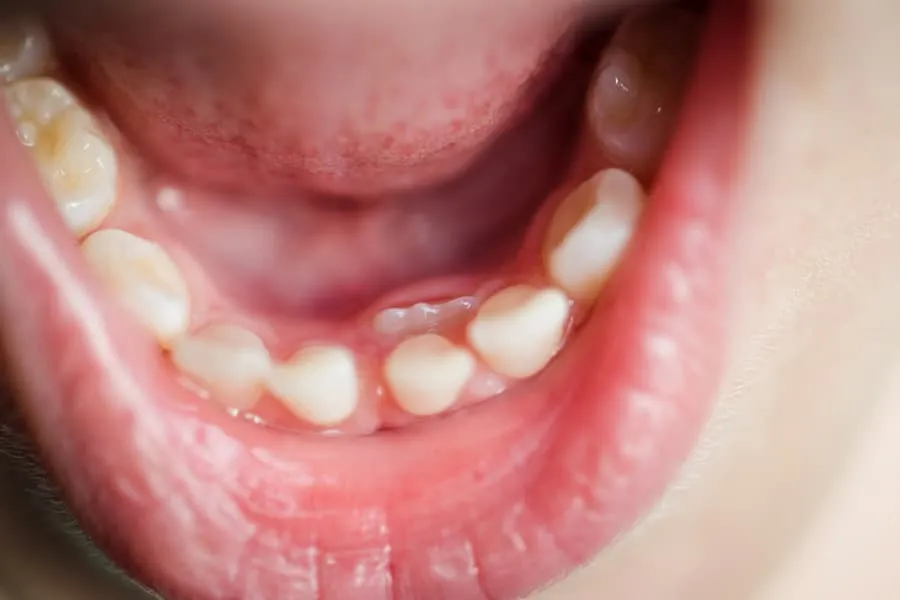
Parents very often tell us that some of their children’s permanent teeth have come in but are not white and clean like the rest. What is happening in this case?
The defect that concerns us most today is “Molar Incisor Hypomineralization (or Hypocalcification)” (MIH), because of its increasing prevalence worldwide. Molar Incisor Hypomineralization (MIH) is a chronological defect: it mainly affects the teeth that mineralize during a specific time window (from birth to a few years later), namely the eight front incisors (upper and lower) and the four first permanent molars. MIH can affect anywhere from one to four molars, and the severity can range from mild to severe in the same person.
It involves the “demineralization” of one or more first permanent molars, and possibly of permanent incisors, which come into the child’s mouth at around 6–8 years of age. These teeth erupt with defective enamel. The affected teeth show scattered hypomineralized patches which, depending on how porous they are, may be white (usually on the incisors) or yellowish to yellow-brown (usually on the molars). These patches do not necessarily appear on all the teeth, have the same color or appear symmetrically on both sides of the jaw. A characteristic feature of hypomineralized molars is that their enamel is less hard, so they wear down quickly and tooth decay progresses rapidly. The risk of tooth decay in the affected teeth increases not only because their enamel is soft and porous, but also because their structural weakness makes them very sensitive to stimuli, such as cold and a tingling sensation when brushing. This makes oral hygiene less effective and therefore speeds up the progression of tooth decay.
Molar incisor hypomineralization is caused by a disruption in the function of the enamel-forming cells (ameloblasts) during the period when the enamel of these particular teeth matures. It has been found to occur more often in children who had health problems during the first 3 years of life, such as premature birth, respiratory infections, infections with high fever and frequent use of antibiotics, although hypomineralized molars can also appear in the absence of any of these.
The need for treatment is therefore urgent. Treating affected molars and incisors is difficult, complex and often long-term. Specifically, the child must practice meticulous oral hygiene at home with their parents’ help, while at the dental office, in mild cases, frequent application of fluoride products (varnishes, fluoride gel) helps, as does placing sealants on the molars immediately after they come into the mouth. If the teeth are restored with composite resin fillings, these may need to be replaced after some time because of the heavy wear they undergo.
Placing stainless steel crowns on the molars, despite their poor appearance, is a very good, low-cost temporary solution, because they protect the tooth and its nerve until the child reaches adulthood. After the age of 18–20, once the growth of the face and jaws is complete, permanent restorations with better aesthetics can be placed. For affected incisors, aesthetic restorations are usually done with resin, with composite veneers or, in more severe cases, with porcelain veneers.
In conclusion, in every case of hypomineralization, whether of the molars alone or of both molars and incisors, what matters is early diagnosis of the problem, in order to prevent the destruction of these teeth. Dental treatment includes an intensive, comprehensive prevention program as well as treatment of the affected teeth.
Quick answers
What is Molar Incisor Hypomineralization (MIH)?
MIH is a defect of the tooth enamel that mainly affects the first permanent molars and the permanent incisors, which come in around ages 6–8. The affected teeth have defective enamel with white, yellowish or yellow-brown patches.
What causes MIH?
It is caused by a disruption in the function of the enamel-forming cells while the enamel of these teeth is maturing. It appears more often in children who had health problems in their first 3 years, such as premature birth, respiratory infections, high fever or frequent antibiotics, but it can also occur without any of these.
Why do teeth with MIH decay more easily?
Their enamel is softer and more porous, so they wear down quickly and tooth decay progresses fast. They are also very sensitive, for example to cold and during brushing, which makes oral hygiene less effective.
How is MIH treated?
It requires meticulous oral hygiene at home and, in mild cases, frequent fluoride varnish or gel and sealants on the molars. Molars can be protected with stainless steel crowns until permanent restorations are placed after age 18–20, while incisors are usually restored with resin or veneers.
This article is for information only and does not replace a clinical examination or your dentist’s advice.