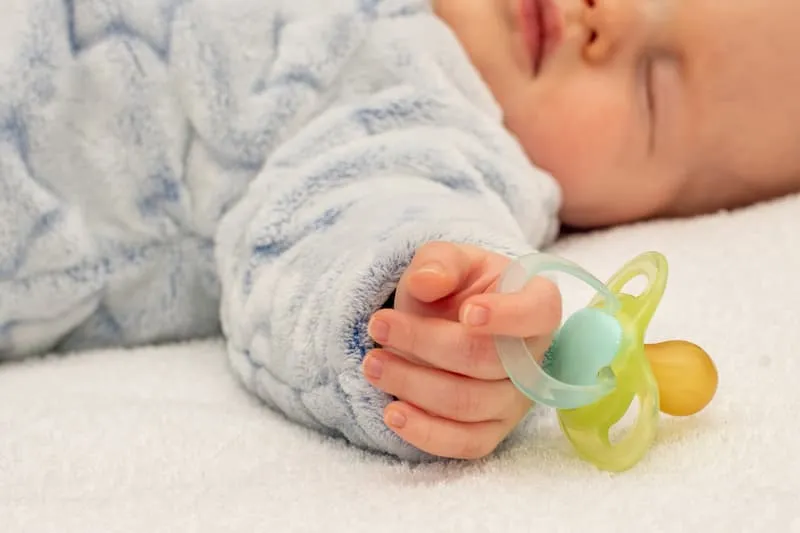
Many babies suck one or more fingers in their mother’s womb, even before they are born. This habit, which continues after birth, makes them feel secure, soothes them and often helps them fall asleep. When your baby comes into the world, they seek your embrace and closeness. Besides providing essential nourishment, breastfeeding also gives your baby the physical contact they need so much. The pacifier “imitates” the mother: it acts as a substitute for her, calming your baby, lulling them to sleep and comforting them.
Some people will certainly tell a mother to give her baby a pacifier, while others will tell her not to. Before doing anything, a mother should follow her own judgment and do what she herself believes will be good for her baby.
However, the position of the teeth and/or the development of the jaws can be affected when the habit is intense and continues for long periods of time.
Problems associated with thumb and pacifier sucking
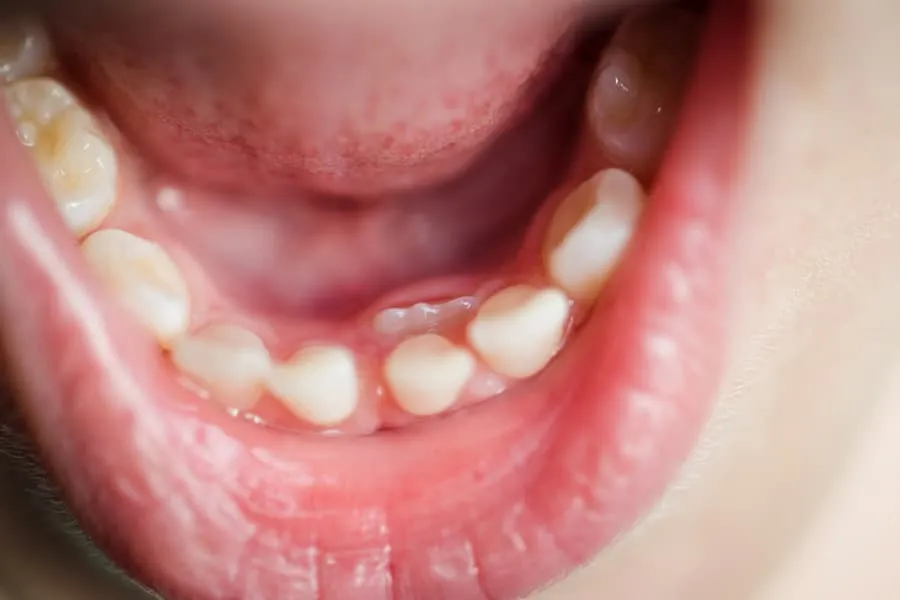
Intense, frequent (throughout the day and night) and prolonged sucking of the thumb or a pacifier can cause problems with a child’s teeth, such as:
- Increased overjet, or “protruding front teeth”: the front teeth do not meet when the mouth is closed.
- A protruding and/or narrow upper jaw.
- A change in tongue position: when the tongue rests between the upper and lower teeth, a “gap” remains between the teeth when the child closes their mouth (open bite).
- A child’s speech development does not seem to be affected by how many hours a day they use a pacifier, but by how many months they keep using it. Speech therapists recommend stopping pacifier use fairly early, specifically at 12–18 months, as this age is considered a milestone in speech development.
Most children stop sucking their thumb or pacifier on their own after the age of four, so the problems above may correct themselves. Using a pacifier is a common way of meeting a baby’s need to suck, and it can also help prevent the thumb-sucking habit.
How to help your child stop thumb or pacifier sucking
There are some simple ways parents and caregivers can help a child break this habit:
- Talk with your child patiently and with understanding, without using belittling words and without frightening them about possible consequences.
- Make up for the sense of security that sucking provides by giving your child more care, time and attention.
- Keep a calendar to record your child’s efforts. At the end of the month, reward your child for trying with something they really want, such as a toy or a visit to their favorite park.
If your child is still sucking their thumb after the age of 5, the dentist can explain to them why they need to stop this habit. Using a pacifier is preferable to thumb sucking, because the pacifier habit is easier to stop.
Quite often, trying to avoid a pacifier leads to thumb sucking, which, as a substitute habit, can have more serious consequences for the development of the jaws.
Choosing the right pacifier can reduce potential problems with your child’s teeth and jaws, as long as it has the following features:
- The pacifier should be large enough that it cannot fit entirely in the child’s mouth. Choose a pacifier that matches your little one’s age group.
- The nipple should be soft, with the thinnest and most flexible neck possible. Its shape should be anatomically symmetrical so that it always sits correctly in the baby’s mouth.
- It should have a flattened shape and a low profile, so that it affects jaw development as little as possible.
- The shield should be curved to fit well around the lips and should have many large ventilation holes, so that saliva does not irritate the skin around the mouth.
- The pacifier should be made in such a way that it is completely impossible for a child to take it apart.
We must stress that attaching a pacifier with a ribbon around the baby’s neck is strictly forbidden, because there is a serious risk of strangulation.
In addition, a pacifier should never be coated with honey, sugar or any other sweetener, as this can cause tooth decay in your child’s teeth. Likewise, a pacifier should never be cleaned in the mother’s mouth with her saliva.
Dear mom, arm yourself with patience and try to wean your little one off the pacifier gradually, making sure above all that both your child and you stay calm. My advice, then, would be to avoid giving your little one a pacifier, but if you find that they love sucking their thumb, give them one without a second thought! As we like to say, you can take away a pacifier, even if it’s hard, but you can’t take away a thumb!
Vasiliki (Vicky) Simopoulou
Military Dental Surgeon
D.D.S., MSc
Specialized in Hospital Dentistry and Oral Medicine, National and Kapodistrian University of Athens
Postgraduate studies in Public Health, National School of Public Health
Contact details: Tooth Experts, 22 Dimitriou Soutsou Street, Athens
Tel.: 211.750.2466, 6934084240
Email: [email protected]
Vasiliki (Vicky) Simopoulou was born in the city of Larissa, where she grew up and spent her school years.

After passing the Panhellenic national entrance exams, she was admitted to the School of Dentistry of the Aristotle University of Thessaloniki, from which she graduated third in her class in July 2014. In October 2014 she also graduated from the Military School of Corps Officers with the rank of Second Lieutenant in the Medical Corps.
She completed her specialty training at the Oral Medicine Clinic of the School of Dentistry, National and Kapodistrian University of Athens, specializing in Hospital Dentistry. She also completed the master’s program in Public Health at the National School of Public Health with the grade “Excellent.”
Since 2009 she has volunteered in community dental programs, and she presents scientific papers at dental and medical conferences both in Greece and abroad. She has attended theoretical and hands-on seminars and keeps continually up to date with scientific developments in dentistry at international conferences. Her research interests focus on restorative dentistry, endodontic treatments (root canal treatment), fixed and removable prosthetic restorations, and newer techniques in both aesthetic dentistry and pediatric dentistry.
Her goal is to build beautiful, healthy smiles and, above all, to encourage her young patients to develop good oral hygiene habits for the years ahead. That is why her sole concern is to provide high-quality dental care in the best possible way, using the most patient-friendly materials and techniques.
She runs a private practice under the name Tooth Experts at 22 Dimitriou Soutsou Street in Athens, where she welcomes patients young and old with a smile and her full dedication.
Quick answers
Can a pacifier or thumb sucking affect my child's teeth?
Yes. When the habit is intense, frequent and continues for long periods, it can affect the position of the teeth and/or the development of the jaws. Possible problems include protruding front teeth, a protruding or narrow upper jaw and an open bite.
When should my child stop using a pacifier?
Speech therapists recommend stopping pacifier use fairly early, at 12–18 months, as this age is considered a milestone in speech development. Most children stop thumb or pacifier sucking on their own after the age of four.
Is a pacifier better than thumb sucking?
Yes, a pacifier is preferable to thumb sucking because the habit is easier to stop. Trying to avoid a pacifier often leads to thumb sucking, which can have more serious consequences for jaw development.
What should I look for in a pacifier?
It should suit your child's age and be too large to fit entirely in their mouth, with a soft, symmetrical, flattened nipple and a thin, flexible neck. The shield should be properly curved with large ventilation holes, and the pacifier should be impossible for a child to take apart.
This article is for information only and does not replace a clinical examination or your dentist’s advice.